
Grief & Loss
- Apr 20
- 5 min read
Updated: Jun 26
Five Years On. Grief Still Does What It Wants.
Today is the fifth anniversary of my dad dying.
Five years. I keep saying it to myself. It still doesn't land right. Some days it feels like yesterday. Other days it feels like a completely different lifetime. Then there are the days nobody warns you about. When it barely registers at all. When you're just getting on with things. Those are the days the guilt shows up.

That guilt, by the way? Completely normal. I'll come back to that.
I'm writing this because grief is something I lived long before I ever trained in any of it. Because the anniversary of a loss has a particular quality. A weight that can catch you completely off guard even when you knew the date was coming.
If you're carrying something similar right now, this is for you.
Nobody tells you grief doesn't follow a schedule
We've all heard about the five stages. Denial, anger, bargaining, depression, acceptance. There's something in that framework, but it gives people the wrong impression. Like grief is a process you move through in order, tick off each stage, reach the end, done.
That's not how it works.
Grief researcher Dr. Mary-Frances O'Connor describes grief as the price we pay for love. A neurological process, not just an emotional one. The brain has to literally rewire itself around the absence of someone it expected to be there. That takes time. It takes repetition. It doesn't happen in a straight line.
Five years on, I can tell you: it changes shape. It doesn't disappear. That's okay.
The bits nobody says out loud
There are parts of grief that people feel ashamed of. The anger. The relief, sometimes, when someone had been suffering. The way you can be completely fine on the day everyone expects you to fall apart. Then be utterly undone by a smell in a supermarket six months later.
The guilt for laughing too soon. The guilt for forgetting, even briefly. The guilt for moving on, even when moving on doesn't mean leaving them behind.
I've felt all of it. In my own life. In the work I do with women who are carrying the weight of their histories, I hear it regularly too.
None of it makes you a bad person. It makes you human, trying to process something enormous.
A few things worth knowing
Because sometimes it helps to know you're not alone in what you're experiencing.
Around 1 in 10 people experience what's known as prolonged grief disorder. Grief that doesn't ease over time and begins to significantly interfere with daily life. If that resonates, please speak to someone or drop me a message and I can put you in touch with help. You don't have to white-knuckle your way through it alone.
Grief anniversaries are real. Research from trauma and neuroscience shows the body holds memory, not just the mind. The nervous system can respond to the approach of a significant date before the conscious mind has even clocked it. If you've felt more on edge, more exhausted, or more emotional lately and couldn't explain why, that might be your body knowing.
Grief and suppressed emotion are connected. Studies in psychoneuroimmunology show that chronic emotional suppression, which many of us were trained into from childhood, affects immune function, sleep, and stress hormone levels. Grief that doesn't get expressed doesn't disappear. It gets stored.
Social support genuinely matters. Research consistently shows that people who have at least one person they can speak to honestly about their grief do better over time. Not someone who rushes you through it. Someone who can actually sit in it with you.
What actually helps
Not quick fixes. Not toxic positivity. Just a few things I've found to be true, in my own experience and in the work I do.
Let the body be part of it.
Grief isn't just a thought you have. It's something your body carries. Crying, moving, breathing, shaking. These aren't signs of weakness. They're the nervous system doing exactly what it's designed to do. If you've been keeping it all in your head and wondering why you feel so flat and heavy, this might be part of why.
Tend to the anniversary deliberately.
Rather than bracing for the date or trying to treat it like any other day, do something intentional. Light a candle. Look at a photo. Go somewhere that meant something to them. Cook something they loved. It doesn't have to be dramatic. Giving the day some acknowledgement can help the nervous system feel less ambushed.
Don't rush the moving forward part.
There's a cultural pressure, especially for women, especially for those of us trained to keep things moving and keep everyone else comfortable, to grieve neatly and on schedule. To be doing well by a certain point.
You don't owe anyone a tidy grief. The mess is allowed.
Notice if old patterns get louder.
For a lot of women, grief, especially around anniversaries, can reactivate old survival responses. The need to hold it together. The reflex to minimise. The sense that your grief is too much or taking up too much space.
If that's happening, it's worth paying attention to. Not as a problem. As information. Sometimes a loss in the present reactivates something much older.
Five years on
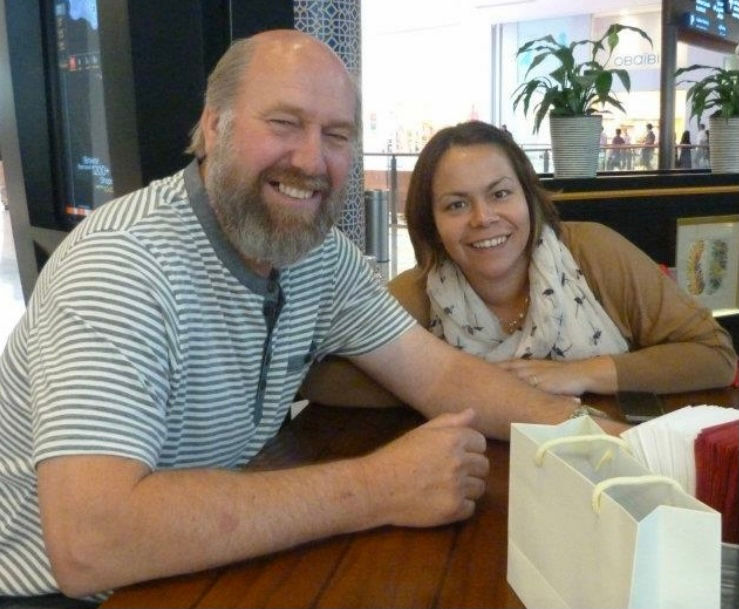
My dad was funny. Proper laugh-until-you-can't-breathe funny. He was also complicated, in the way most people who shaped us are complicated. Grief, for me, has never been just about loss. It's been about holding all of it. The love, the complexity, the things that were never said, the relationship that keeps shifting and evolving in me even though he isn't here.
That's the thing about grief that nobody puts on the cards. It doesn't end because the person is gone. The relationship doesn't end. It just changes form.
If you're approaching an anniversary, or carrying a loss that still sits heavy, I hope something in here was useful.
If this is sitting somewhere in your body and affecting how you're living now, that's something we can work with. Not by talking it to death. By going somewhere deeper.
You don't have to keep carrying it alone.
If this resonated and you're ready to talk, book a free 30-minute Connection Call. No obligation. Just a conversation.
Loretta x
Loretta Davie Coaching · loretta-davie.co.uk · Gloucestershire
Sources
Lundorff et al. (2017). Prevalence of prolonged grief disorder. Journal of Affective Disorders.
O'Connor, M.F. (2022). The Grieving Brain. HarperOne.
O'Connor, M.F. (2019). Grief: A Brief History of Research on How Body, Mind, and Brain Adapt. Psychosomatic Medicine.
Kiecolt-Glaser et al. (2009). Psychoneuroimmunology: Psychology's Gateway to the Biomedical Future. Perspectives on Psychological Science.
Eisma et al. (2021). Harnessing Social Support for Bereavement. PMC.


Comments